WhatsApp
AI voice · 4 min read · SpatiaMed Team
AI Voice Agents for Healthcare: The Future of Patient Communication
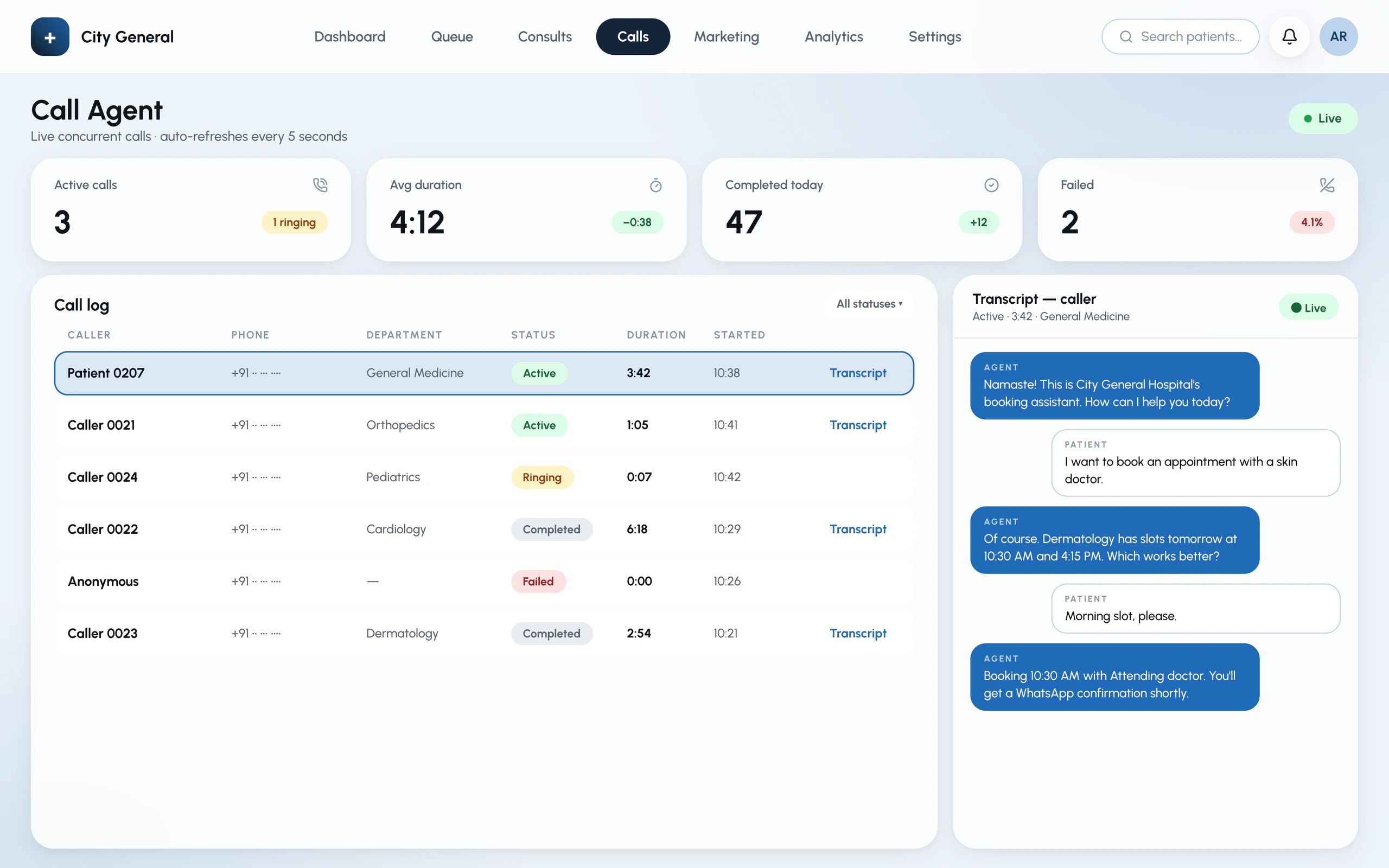
AI voice agents are answering patient calls in multiple Indian languages, booking appointments (or holding them for staff to confirm), and recovering missed calls — so reception isn't the only line. Here's how the technology works and what it means for hospitals.

A patient calls a hospital at 8 PM to ask about OPD timings and doctor availability. The receptionist went home at 7. Under the old model, the call goes unanswered and the patient Googles a competitor.
Under the new model, an AI voice agent answers in the patient's preferred language, confirms the OPD schedule, checks doctor availability, and books the slot — or holds it for the hospital's team to confirm in the morning, if that's how the hospital set it up.
This is not science fiction — we're piloting it with hospitals across India.
What an AI Voice Agent Is (and Isn't)
An AI voice agent is a conversational software system that can:
- Answer an incoming call
- Understand natural language in the patient's language (Hindi, Tamil, Telugu, Kannada, Marathi, Bengali, and others)
- Respond with natural-sounding speech (not the robotic "press 1 for billing" IVR)
- Complete simple tasks: confirm OPD timings, book an appointment (or hold it for staff to confirm), take a callback request, provide directions, check appointment status
What it is not (at this stage of the technology):
- A replacement for clinical decision-making
- Capable of medical advice or triage
- Appropriate for complex complaints requiring empathy and judgement
The design principle is to automate the commodity interactions — "What are your OPD hours?", "Can I book an appointment with the cardiologist?", "I want to cancel my appointment for tomorrow" — while routing anything complex or sensitive to a human staff member.
The Multilingual Requirement
India's linguistic diversity is the central challenge for any voice technology in healthcare. A patient calling from a rural district in Tamil Nadu expects to be understood in Tamil. A patient in Kolkata expects Bengali. A patient from UP expects Hindi.
Modern AI voice systems trained on Indian language speech data can now handle conversational queries in 10 Indian languages + English with high accuracy. The key capabilities to look for:
Code-switching support: Indian patients often mix languages within a single sentence ("Mujhe Monday ko cardiologist ke saath appointment chahiye"). The system must handle this naturally.
Accent variation: Hindi spoken in Bihar sounds different from Hindi spoken in Delhi or Mumbai. Language models trained only on standard pronunciations will fail on regional accents.
Low-bandwidth resilience: Many patients call from mobile networks with variable audio quality. The voice recognition system must perform on compressed, noisy audio, not just studio-quality speech.
Use Cases That Work Today
After-hours call handling: The most immediate use case. Capture all calls that come in outside staffing hours. The agent answers, collects the query, and either resolves it (timings, directions) or creates a callback task for the next morning.
Missed call recovery: When a call is missed during business hours, the AI agent can call back within 60 seconds and collect the patient's query or appointment request. Recovery rates are 35–60% of missed callers who receive a callback within 5 minutes.
Appointment confirmation: Instead of a receptionist calling 50 patients the day before their appointment to confirm, the AI agent makes all 50 calls automatically. Patients who want to cancel can do so in the same call; others receive a WhatsApp follow-up.
Post-discharge check-in: A scripted check-in call 48 hours after discharge: "How are you feeling? Any concerns about your medication?" This captures early warning signs that might require intervention and significantly improves patient satisfaction scores.
What the Technology Cannot Do
Transparency about limitations is important, both for setting expectations and for managing clinical risk.
Voice agents must never:
- Provide a diagnosis or clinical interpretation ("Your symptoms sound like X")
- Advise on medication dosing or interactions
- Handle calls from distressed patients without offering immediate human transfer
- Make any statement that could be construed as a medical recommendation
The call flow must always include a clear path to a human: "Press 0 or say 'connect me to someone' at any time to speak with our staff."
Implementation Considerations
Phone system integration: AI voice agents typically connect to your existing phone number via SIP trunking or a forwarding rule. No new hardware is usually required.
Script design: The agent's conversation design matters as much as the underlying technology. A poorly designed flow that confuses patients is worse than no agent at all.
Escalation protocol: Define clearly what triggers a transfer to a human (patient distress, clinical queries, repeated failures to understand). Monitor escalation rate — high escalation means the agent scope is too broad.
TRAI compliance: Outbound calls made by AI agents are subject to TRAI's calling regulations. Calls before 9 AM or after 9 PM are prohibited. Patients must be able to opt out of automated outbound calls.
SpatiaMed's AI Front Desk answers calls and calls back missed callers in 10 Indian languages + English, and files each booking as a request your front desk confirms. Book a demo to hear a sample conversation in your preferred language.
Related: AI Front Desk — an AI receptionist for hospital calls.
Keep reading
 patient communication
Why Hospital Phone Calls Go Unanswered (And How to Fix It)
 hospital software
Comparing Hospital Management Software in India: 2026 Guide